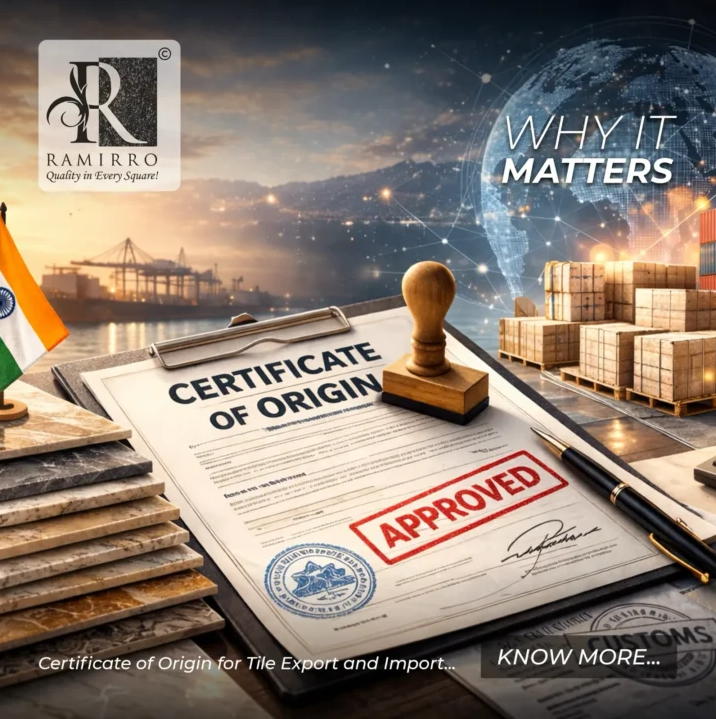
In international tile trade, paperwork matters as much as product quality. One document that plays a decisive role is the certificate of origin, which confirms where tiles are manufactured and determines the import duty applied at customs. For importers, developers, and distributors, this document directly affects cost, compliance, and clearance speed. Ramirro Ceramica, a globally active tile manufacturer and exporter, structures its export processes around accurate origin documentation to support smooth, transparent, and compliant tile trade across international markets.
Certificate of Origin Explained
When tiles cross international borders, customs needs clear proof of where they are made. A Certificate of Origin (COO) is the official document that confirms the country in which the tiles were manufactured, helping customs classify the shipment correctly.
A Certificate of Origin is not an invoice or a packing list, and it is not optional. Customs authorities use it to apply the right import rules, decide the correct duty, and verify whether the shipment qualifies for benefits under trade agreements.
Tiles are sensitive to origin checks because duties and trade benefits change from country to country. The same tile can attract different duty rates based solely on its verified origin, which is why customs relies on the Certificate of Origin to assess duty, FTA or CEPA eligibility, and any safeguard measures.
Related Post
- Journey of Kilns: Six Ancient Kilns to Industrial Ceramic Firing
- Types of Ceramic Glazes and the Finishing Effects They Bring to Tiles and Ceramics
- Cheap Tiles vs Expensive Tiles: A Clear, Practical Look at Pricing, Quality, and Value in Ceramic & Porcelain Tiles
- Certificate of Origin for Tile Export and Import: Why It Matters in Global Trade
- India–EFTA Trade and Economic Partnership Agreement: What the New Trade Deal Means for the Tiles Industry
- UK-India CETA Trade Deal Explained: A Complete Guide to Trade in Goods and Tile Imports in the United Kingdom
- ASEAN Ceramics and Tile Market in Southeast Asia: Understanding Ceramic Industry Trends and Selecting a Reliable Tile Supplier in Malaysia
- Preferential Trade Agreement Explained: How India MERCOSUR Trade Agreements Shape Market Access
- Best Tiles in South Korea Under Free Trade Agreements: Porcelain Wall and Floor Tile Trends
- Best Tiles in Singapore from a Leading Tile Supplier — How Free Trade Agreements Improve Tile Value
- India Oman Free Trade Agreement: What It Means for Ceramic and Porcelain Tile Export and Import
- Imported Tiles in New Zealand: How the India Free Trade Agreement Creates Price Benefits and Cost Advantages for Tile Importers
- Salone del Mobile 2026 in Milan: Complete Guide to Salone del
- INDEX Exhibition Dubai 2026: Interior Trends & Highlights in UAE
- March 2026 Tiles Exhibition: Guide to Global Tile & Ceramic Fairs
- Tile Shade Accuracy: Munsell Color System for Color Consistency
- Tile Trends 2026: Porcelain Designs for Bathrooms & Kitchens
- Japandi Style Tiles: Peaceful Interiors with Functional Spaces
- Island Flooring Design Inspiration: Best Tile Ideas for Home Floors
- Alfresco Area Design Ideas: Right Tiles for Stylish Outdoor Living
- Best Tiles in New Zealand: Floor & Wall Tiles Under Free Trade
- Coastal Architecture Tiles Across the World’s Coastal Climates
- Best Tiles for Australian Climate: Heat Resistant and Slip Resistant
- Australian Tile Standards for Porcelain and Ceramic Tile Installation
- Live Tile Price Calculator: Check Latest Prices for 200+ Tile Variants
- Urban Design Inspired Tiles: Better Surfaces for Better Cities That Are Durable, Stylish and Sustainable
- 대한민국 서울에서 사용되는 타일 종류: 벽면 및 바닥용 도자기 타일과 세라믹 타일에 대한 설명